Investigating English across the globe
World Wide Words
From the Weird Words section
Chatoyant
Pronounced /ʃəˈtɔɪənt/
Though we might define this word in general to refer to something having a changeable, varying lustre or colour, no two dictionaries entirely agree on its current apoplication.
Some mention only the bright lustre of a gem caused by reflections from within the stone, since the word now most often appears in discussions by gemologists; but other dictionaries mention the sheen of a bird’s plumage or the changing colours and texture of a material such as silk.
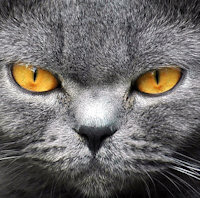 Chatoyant, in the dark ...
All agree, however, that the source of the concept is the gleam of a cat’s eyes in the dark. The source is the eighteenth-century French verb chatoyer, to shine like a cat’s eyes (based on chat, French for cat). Its French connections remain so strong that it is still sometimes said as though it were a French word (/ʃætwæjɑ̃/, roughly “cha-twai-yan”).
Many examples in English literature refer to shining eyes, as in The Insidious Dr Fu-Manchu, by Sax Rohmer, of 1913: “I managed to move sufficiently to see at the top, as I fired up the stairs, the yellow face of Dr. Fu-Manchu, to see the gleaming, chatoyant eyes, greenly terrible, as they sought to pierce the gloom.”
Support this website
Over the past 30 years, World Wide Words has chronicled the shifting English wordscape — new coinages, word histories, books on language, curious idioms, and the oddities of native English speech. More than 3,000 articles are archived here for you to enjoy.
There are no advertisements to interrupt your reading pleasure. I rely on your generosity to cover running costs. Donations made via PayPal are secure.