Investigating English across the globe
World Wide Words
From the Weird Words section
Zograscope
Pronounced /ˈzɒɡrəskəʊp/
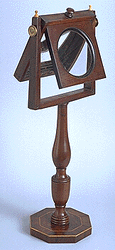
An eighteenth-century zograscope made from mahogany
The zograscope, consisting of a lens and mirror on a wooden stand, was a device of the eighteenth century for viewing what were called perspective prints — pseudo-stereoscopic images — sometimes also known as vues d’optique. It was named the Zograscope for reasons that are now lost to us, though it was also more variously and prosaically called a diagonal mirror, an optical pillar machine or an optical diagonal machine.
The picture to be viewed was placed on a table and observed through a slanting mirror by means of a lens large enough to allow both eyes to see the picture at once. Its curved edges distorted the image to give a surprisingly good sensation of depth. The surviving examples are highly collectible pieces of elegant mahogany furniture, designed for the drawing rooms of well-to-do families who desired the latest in technology for their after-dinner entertainment.
They wanted, to quote a catalogue of 1784, to look at “remarkable Views of Shipping, eminent Cities, Towns, Royal Palaces, Noblemen and Gentleman’s Seats and Gardens in Great Britain, France and Holland, Views of Venice, Florence, Ancient and Modern Rome, and the most striking public Buildings in and about London”. These pictures were available at a price of a shilling plain or two shillings coloured, a substantial sum for the period.
Support this website
Over the past 30 years, World Wide Words has chronicled the shifting English wordscape — new coinages, word histories, books on language, curious idioms, and the oddities of native English speech. More than 3,000 articles are archived here for you to enjoy.
There are no advertisements to interrupt your reading pleasure. I rely on your generosity to cover running costs. Donations made via PayPal are secure.