


Weeds in the Garden of Words
About a year ago, I reviewed Kate Burridge’s earlier book Blooming English: Observations on the roots, cultivation and hybrids of the English language and mentioned that a sequel had been published in Australia. Like its predecessor, it has now been republished by Cambridge University Press.
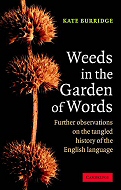
As the title suggests, in this book she concentrates on some of the aspects of English that might be regarded as non-standard or wrong, such as jargon, slang, and euphemism. She also writes about the way that false ideas about word origins can grow on fertile ground, and how words can radically change their spellings and their meanings over time (one of her examples is gravy, which in the medieval period was written as graney, until it was changed by a scribe who misread another scribe; it’s from Old French grané).
A later chapter looks into some of the grammatical puzzles that have been bequeathed to us through language change, such as the difficulty we have choosing between less and fewer (she argues convincingly that constructions like ten items or less will in time oust the forms using fewer) and why we have so many oddities of spelling and pronunciation (one of her illustrations is schism, which can be said three ways — skism, sism and shism).
She writes chattily and clearly, with no linguistic jargon, and her book is an easy ride through some of the complexities and oddities of the language. A few things caused me to draw breath: she’s awry with her attempt to explain the exception proves the rule; terms like the bee’s knees are earlier than the 1930s; my own work has improved on her dating of gravy train; it is now extremely rare to hear the name of the Cotswold town of Cirencester said as sis-etter (and certainly never as sister). These are minor blemishes on a entertaining book that shows Professor Burridge’s grasp of the history of our language as well as her love of gardening.
[Kate Burridge, Weeds in the Garden of Words: Further observations on the tangled history of the English language, published by the Cambridge University Press on 16 June 2005; hardback and paperback published simultaneously, pp196; publisher’s prices £35.00 for hardback (ISBN 0521853133), £12.99 paperback (ISBN 0521618231). First published in Australia by ABC Books in Aug. 2004, AUS$24.95; ISBN 0733314104 (paperback).]