Investigating English across the globe
World Wide Words
From the Reviews section
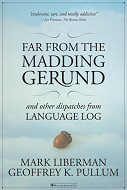
Far From the Madding Gerund
This book is a collection of articles written by two professional linguists, Mark Liberman and Geoffrey K Pullum, all of which were first posted on their Web site, the Language Log. The theme of the site is grammar and correctness in English.
To take some pieces pretty much at random, the authors express hate for that supposed arbiter of correctness, Strunk & White, a “horrid little book”, which they castigate — among other awful sins — for prohibiting sentence-initial however. They bewail the abandonment of grammar teaching in American schools (a view often echoed in the UK), in particular being alarmed at errors of grammar in the official answers to recent SAT practice questions. They patiently explain that Inuit languages really don’t have 80, or 150, or however many words for types of snow, and why. There’s a wonderful deconstruction of the first few paragraphs of that dreadfully written book, The Da Vinci Code. They discuss why wedding vowels often appears when wedding vows is meant. In the section Learn your grammar, Becky, with the subtitle “some disastrously unhelpful guidance on usage”, an article on misplaced modifiers includes this example quoted in the Penguin Dictionary of American English Usage: “Although widely used by the men, Bashilange women were rarely allowed to smoke cannabis”.
This is a book to dip into, not to be read straight through. Nobody will find every item interesting — a discussion of how to pronounce the name of the Iraqi city Samarra, which introduces subtleties of Arabic pronunciation, may be passed over without loss, though you might like to know it means “happy is he who sees it”; the article on analysis of discourse structures will glaze the eyes of anybody not in the field. If you’re flummoxed by such grammatical terms as hierarchical ontology, predicate, nominalisation, count noun, or prepositional phrase, you perhaps ought to give the book a miss. If you’re not sure, the miracle of the Web means you can test-read articles by popping over to the Language Log site.
The book is an example of what looks like a trend: the conversion of blogs into books, or blooks. Every article in the book is still available on the Language Log. So why pay money for what you can read for free? That’s a good question that only the publisher’s sales figures may ultimately answer, but it does suggest that the old-fashioned ink-on-dead-trees, no-batteries-required, go-anywhere book still has some life in it.
[Mark Liberman and Geoffrey K Pullum, Far From the Madding Gerund and Other Dispatches from the Language Log; published by William, James & Co, Oregon, on 1 May 2006; ISBN 1590280555; paperback, pp360; publisher’s price US$22.00.]
Support this website
Over the past 30 years, World Wide Words has chronicled the shifting English wordscape — new coinages, word histories, books on language, curious idioms, and the oddities of native English speech. More than 3,000 articles are archived here for you to enjoy.
There are no advertisements to interrupt your reading pleasure. I rely on your generosity to cover running costs. Donations made via PayPal are secure.