Investigating English across the globe
World Wide Words
From the Questions & Answers section
Wild West
Q From Robert Englund: On a recent episode of a BBC panel quiz programme (apologies for my not being able to remember which one) we learned that the phrase Wild West was coined, not by Frederic Remington, not by Zane Grey, but by Charlotte Brontë. Can this possibly be right?
A In one sense, the answer is correct, since at the moment the first citation for Wild West in the Oxford English Dictionary is dated 1849 and is from Charlotte Brontë’s novel Shirley: “What suggested the wild West to your mind?” In another sense, it’s utterly inaccurate.
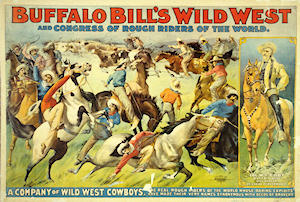
Later a show ... A poster advertising Buffalo Bill’s Wild West show, c1899.
That’s because the entry for Wild West appeared in the Whisky-Wilfulness fascicle of the OED published in November 1924. At that time, access to early American sources was nowhere near as good as it is now and digital databases, of course, hadn’t been thought of. When the entry is revised, I’m certain that it will take the term back at least a couple of decades.
My own research finds this, for example:
He was the first white man in Old Kentucky, and the wide wild west is full of his licks.
The Literary Chronicle and Weekly Review, 19 Jul. 1823. The article is an extract from Memorable days in America by William Faux and this comment is about Daniel Boone. Note that the Wild West wasn’t as far west in those early days as it became later.
By the 1830s, Wild West had become moderately well known in the US and was becoming so in the UK. For Charlotte Brontë to employ it in 1849 is unsurprising — the term by then was well established on both sides of the Atlantic.
Support this website
Over the past 30 years, World Wide Words has chronicled the shifting English wordscape — new coinages, word histories, books on language, curious idioms, and the oddities of native English speech. More than 3,000 articles are archived here for you to enjoy.
There are no advertisements to interrupt your reading pleasure. I rely on your generosity to cover running costs. Donations made via PayPal are secure.