Investigating English across the globe
World Wide Words
From the Questions & Answers section
Kick the Bucket
Q From Fred: Could you tell me where the phrase kick the bucket originated?
A This is one of many idioms created down the years to avoid making too blunt a mention of the unpleasant subject of death by cloaking the idea in euphemistic, elevated or humorous terms. They range from Shakespeare’s shuffle off this mortal coil, through the eighteenth-century’s hop the twig, to George Eliot’s join the choir invisible, many of which were guyed in Monty Python’s famous dead parrot sketch.
The earliest unequivocal appearance of kick the bucket, at least so far as we know at the moment, was in a serial story in a British magazine. At this point the hero, a sailor, has recovered from a severe illness:
My old mess-mate, Tom Bowline, met me at the gangway, and with a salute as hearty as honest, damn’d his eyes, but he was glad I had not kicked the bucket; while another swore roundly, that I had turned well to windward, and left death and the devil to leeward; and a third more vociferously exclaimed, I was born to dance upon nothing.
The History of Edward and Maria, in The London Magazine, Aug. 1775. To dance upon nothing meant to die by hanging.
In the same magazine five years later, a writer confirmed the meaning of the idiom while commenting how opaque it was. It had turned up in a gossipy letter which a friend had received and passed on to him, which included the sentence “as to your enquiries about old Wentworth, poor man! he died extremely rich; his disease stuck so close to him that it has obliged him to kick the bucket”. The article writer noted:
I should have been at a loss also to have known the significance of kicking the bucket, but am told it is an expression used to inform us of a person’s death, although I should no sooner apprehend it to be so than if I were told he had let fall his watch, or rapped at my door.
Observations on the Errors and Corruptions that Have Crept into the English Language, in The London Magazine, May 1780.
So much for the early history of the idiom, which does little or nothing to illuminate its origins. These may never be known for certain, though theories abound.
One story, hard to credit, is that the bucket is one on which a suicide might stand when hanging himself — kick away the bucket and the job is done. This theory only appeared long after a report in a Bath newspaper on 25 September 1788 of the suicide of a man called John Marshfield, who killed himself in just this way; in 1896 John Farmer and William Henley noted in Slang and Its Analogues that it had been claimed as the sad end of an ostler at an inn on the Great North Road.
Farmer and Henley place greater credence on a very different story, which was given rather more support than it deserved by being tentatively suggested as the origin in the first edition of the Oxford English Dictionary in 1888. An extended version of the attribution appeared 15 years later in a letter from the splendidly named Holcombe Ingleby of Norfolk, which he said was “one familiar to me from my youth up”:
When a butcher slings up a sheep or pig, after killing, he fastens to the hocks of the animal what is technically known in the trade as a gambal, a piece of wood curved somewhat like a horse’s leg. This is also known in Norfolk as a bucket. ... Bucket, I may add, is not only well known in Norfolk in this sense, and commonly used, but with some of our folk is the only word known for the article in question. To “kick the bucket,” then, is the sign of the animal’s being dead, and the origin of the phrase may probably, if not indisputably, be referred to this source.
Notes and Queries, 21 May 1904. His gambal is usually rendered as gambrel or gambril, which is presumably why he stated that he couldn’t find the word in the New English Dictionary (the name then for what is now called the Oxford English Dictionary).Editor Henry Bradley had actually included gambrel in the F-G volume published in 1901.
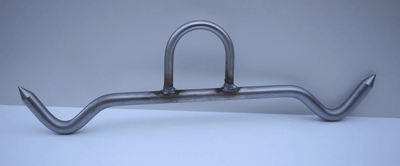
Is this a bucket I see before me? No, it’s a modern butcher’s stainless steel gambrel.
The OED’s editors suggested that the word might not refer to our modern bucket, but to the Old French buquet for a balance or a trebuchet, the medieval siege weapon for hurling missiles at the enemy.
It may reasonably be objected that the animal couldn’t possibly kick the bucket, as it was already dead by the time that its rear legs were fastened to it. Advocates of this origin must also explain how a specialist dialect expression from rural Norfolk came to be so widely taken up at the end of the eighteenth century and why there are only indirect references to this sense of bucket and never any examples of its actually having being uttered.
A third theory also appeared in Notes and Queries, in 1947. It was in reference to a supposedly old custom of the Catholic church:
After death, when the body had been laid out, a cross and two lighted candles were placed near it, and in addition to these the holy-water bucket was brought from the church and put at the feet of the corpse. When friends came to pray for the deceased, before leaving the room they would sprinkle the body with holy water. So intimately therefore was the bucket associated with the feet of deceased persons that it is easy to see how the saying came about.
Or perhaps not.
[This piece is an updated and enlarged version of one that first appeared in this newsletter in February 1999. My thanks to the various members of the American Dialect Society who discovered the early examples, and to etymologist Professor Anatoly Liberman, who wrote about the expression in two issues of his blog The Oxford Etymologist in February 2016.]
Support this website
Over the past 30 years, World Wide Words has chronicled the shifting English wordscape — new coinages, word histories, books on language, curious idioms, and the oddities of native English speech. More than 3,000 articles are archived here for you to enjoy.
There are no advertisements to interrupt your reading pleasure. I rely on your generosity to cover running costs. Donations made via PayPal are secure.