Investigating English across the globe
World Wide Words
From the Questions & Answers section
Gone for a Burton
Q From Nick Carrington: What's the origin of the phrase gone for a Burton, please?
A In informal British English, something that has gone for a Burton is broken, ruined or destroyed.
The original sense was to meet one’s death, a slang term in the RAF in World War Two for pilots who were killed in action. RAF aircrew was noted for being extraordinarily superstitious and, as one part of this, it was regarded as bad luck to say flatly that a man had died or was missing in action. The euphemism most widely used was that he’d gone for a Burton.
Its first recorded appearance in print was in the New Statesman on 30 August 1941, in which it was glossed briefly as “crash”. In the Aeronautical Review of March 1942, it is said to mean “Killed in action”. The same month, the journal Canadian Aviation gave a similar definition. Several other journals reported the idiom the same year.
The first known use of the expression in real life rather than a slang dictionary came later that year. It was in a article about the British actor John Justin, a pilot in the RAF who had been temporarily released from duty to work on a feature film designed to improve the image of the Auxiliary Territorial Service (ATS), which had the working title of We’re Not Weeping but was released as The Gentle Sex:
“I joined the R.A.F. at the outbreak of war,” he said. “While I was still a ‘sprog,’ I was released to finish ‘The Thief.’ It was during the ‘phoney war,’ and I wasn’t getting much flying, anyway, I went to Hollywood, and got back here in July, 1940. I had just been made an instructor when I hit a tree, ‘pranged’ my ‘crate,’ and smashed myself up. I nearly died after that ‘shaky do,’ but got back to flying again, and only a bit of a scar on my forehead now shows. I was lucky, for I thought I’d gone ‘for a Burton.’ “
The Australian Women’s Weekly, 17 Oct. 1942. A sprog was a trainee; a crate was an aircraft; to prang one was to crash it; a shaky do was nearly a serious accident. The Thief in full is The Thief of Baghdad.
A detailed description of the expression appeared in a letter to the American magazine Time the following year:
No mention of our slanguage is complete without mention of our most famous phrasing, and that is the expression “gone for a Burton.” When anything or anybody is through for good, it or he is said to have “gone for a Burton.” ... If one of your “oppos” (universal term for buddies) is killed, you don’t say he was killed, you just say, “Poor old Joe has gone for a Burton.” ... There is an origin to this expression. One of the most popular beers in prewar England was Burton beer. If anyone was wanted and he wasn’t around, it was said that he had “gone for a Burton,” for more often than not, he was to be found in the nearest pub.
Leading Aircraftman Wm. J. L. Gibbons of Calgary, Alberta, in Time, 19 Apr. 1943.
The expression got to Canada because thousands of British aircrew were sent there to train from 1940 onwards.
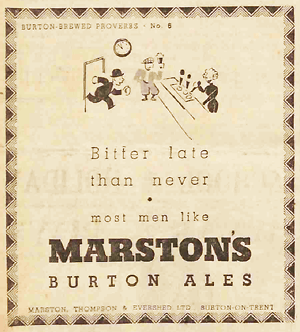
An advertisement for Marston’s beer in April 1937.
About a dozen possible origins have been put forward for the origin of the expression, ranging from an obscure bit of naval apparatus called a Spanish Burton, a dangerous method of stowing barrels in a ship’s hold, a suit from Montague Burton, or Morse code training schools above his shops. This plethora of possibilities indicates how much interest there has been in this archetypal bit of World War Two slang and how little we know of its origins.
Mr Gibbons’ suggestion for the origin is plausible because Burton-on-Trent had for more than a century been a major centre of beer production in England because of the excellent quality of the local water and good transport connections. Burton ales, as a generic term, was widely used by local brewers such as Bass, Truman’s, and Marston’s. Hence Burton was an elliptical way to refer to a glass of beer.
The link was the basis of at least two of the evidence-free suggested origins that have appeared. One held that it first referred to aircraft having to ditch in the sea, to end up in the drink, so the idiom was black humour implying the pilot was in search of a beer. It is also said that a series of advertisements for beer in the interwar years featured a group with one person missing (a football team with a gap in the line-up, a dinner party with one chair empty). The tagline suggested the missing person had just popped out for a beer — had gone for a Burton. The slogan was then supposedly taken up by RAF pilots for one of their number missing in action. The problem with it is that nobody has been able to trace the advertisements.
On the other hand, there’s plenty of evidence that British pilots and aircrew loved their beer. I’d put my money on its being the source. Can’t prove it, though. Sorry.
Support this website
Over the past 30 years, World Wide Words has chronicled the shifting English wordscape — new coinages, word histories, books on language, curious idioms, and the oddities of native English speech. More than 3,000 articles are archived here for you to enjoy.
There are no advertisements to interrupt your reading pleasure. I rely on your generosity to cover running costs. Donations made via PayPal are secure.